By Matt Rooney
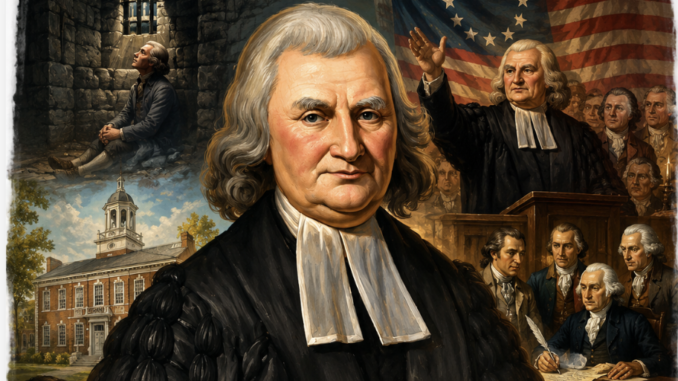
We’re continuing our Independence Day series on New Jersey’s signers of the Declaration of Independence, Save Jerseyans, and few lives illustrate the remarkable diversity of America’s founding generation better than that of John Witherspoon.
Unlike most of the men who pledged their lives, fortunes, and sacred honor in Philadelphia, Witherspoon wasn’t born in the American colonies. He first saw the light of day on February 5, 1723, in the parish of Yester near Edinburgh, Scotland, the son of a Presbyterian minister. Yet despite beginning life thousands of miles away, no signer would leave a deeper intellectual imprint on the American Republic.
Witherspoon’s upbringing immersed him in the traditions of the Scottish Reformation and Presbyterian theology. He studied at the University of Edinburgh before entering the ministry at a remarkably young age, earning a reputation as both an accomplished preacher and gifted scholar. His convictions came at a personal cost. During the Jacobite uprising of 1745, which sought to restore the Catholic Stuart monarchy to the British throne, Witherspoon openly supported the Protestant Hanoverian government. After the Jacobite victory at the Battle of Falkirk, he was captured and imprisoned for several weeks in Doune Castle before eventually being released.
The experience left an enduring impression. It reinforced his lifelong suspicion of concentrated political power and strengthened his belief that religious liberty could only survive where government remained limited and accountable.
Over the next two decades, Witherspoon became one of Scotland’s leading Presbyterian ministers and authors. His writings criticizing theological liberalism and moral decline gained attention on both sides of the Atlantic. They also caught the eye of two Americans: New Jersey lawyer Richard Stockton, whom Witherspoon had met while Stockton studied abroad, and Pennsylvania physician Benjamin Rush.
Their recruitment effort would permanently alter American history.
In 1768, Witherspoon accepted an invitation to become president of the struggling College of New Jersey in Princeton. The institution—known today as Princeton University—was primarily a training school for Presbyterian ministers. Under Witherspoon’s leadership, it became something far greater.
He modernized the curriculum, expanded enrollment, strengthened the faculty, and emphasized classical education, philosophy, history, rhetoric, science, and moral philosophy alongside theology. His goal wasn’t simply to produce ministers. He wanted to educate statesmen capable of governing a free people.
Few educators in American history have assembled a more remarkable classroom.
His students included future President James Madison, future Vice President Aaron Burr, future Supreme Court Justice Henry Brockholst Livingston, numerous governors, senators, judges, military officers, and cabinet members.
Madison, in particular, absorbed Witherspoon’s lessons about the realities of human nature. The Presbyterian minister taught that because men were imperfect, government itself must be carefully designed to restrain ambition and prevent abuses of power. Historians have long noted the influence these ideas had on Madison’s later constitutional thinking, especially his arguments concerning checks and balances and separated powers.
Although deeply rooted in Christian orthodoxy, Witherspoon also embraced the best aspects of the Scottish Enlightenment. He insisted students engage with competing viewpoints—even those he believed were profoundly mistaken. He assigned the works of philosophers such as David Hume despite famously referring to Hume as an “infidel.” Witherspoon believed truth became stronger when tested against error rather than sheltered from it.
As tensions between Great Britain and the colonies intensified during the early 1770s, Witherspoon increasingly viewed British policy through the lens of his own experiences in Scotland. Beyond taxation and representation, he feared growing attempts by the Crown to exercise greater authority over colonial religious life. To a Presbyterian who had witnessed political interference in church affairs firsthand, such developments threatened both civil and religious liberty.
His influence soon extended well beyond the classroom.
In 1774, Witherspoon joined New Jersey’s Committee of Correspondence and Committee of Safety, helping coordinate resistance to British policies. He was later elected to the Continental Congress, where Congress President John Hancock appointed him congressional chaplain.
Long before the age of radio and television evangelists, John Witherspoon had effectively become America’s sermonizer-in-chief.
On May 17, 1776—just weeks before independence—he delivered one of the Revolution’s most influential sermons, The Dominion of Providence over the Passions of Men. Printed and distributed throughout the colonies, it argued that resistance to tyranny was consistent with both reason and Christian faith.
Rather than indulging in emotional attacks against King George III or the British people, Witherspoon instead offered a sober argument grounded in human nature:
“I call this claim unjust… because they are separated from us, independent of us, and have an interest in opposing us.”
His reasoning reflected a broader principle that would later permeate the Constitution itself: governments cannot safely exercise unchecked power over people whose interests they neither share nor adequately represent.
When debate over independence reached its climax in the summer of 1776, some delegates remained hesitant.
Witherspoon was not among them.
He declared that America “was not only ripe for the measure, but in danger of rotting for the want of it,” helping stiffen the resolve of wavering delegates before adding his own signature to the Declaration of Independence as New Jersey’s only clergyman among the signers.
The Revolution soon came directly to Princeton.
Although well beyond military age, Witherspoon’s son, James, served as a major in the Continental Army and was seriously wounded at the Battle of Germantown. Meanwhile, British and American armies repeatedly occupied Princeton, forcing Witherspoon to suspend classes and temporarily close the College of New Jersey for the safety of its students and faculty.
The conflict left Nassau Hall badly damaged. Following the war, Witherspoon personally contributed funds and helped oversee its reconstruction, ensuring that the institution he had transformed would survive for future generations.
His public service hardly ended with independence.
Between 1777 and 1784, Witherspoon served on more than one hundred congressional committees, tackling matters ranging from finance and military affairs to diplomacy and public administration. He also helped draft the Articles of Confederation, the nation’s first governing framework.
Although the Articles ultimately proved too weak to sustain the young republic, Witherspoon recognized their shortcomings and became a vigorous supporter of the proposed United States Constitution. During New Jersey’s ratification debates, he enthusiastically backed the new framework—one heavily influenced by his former student, James Madison.
In many respects, the intellectual lineage is unmistakable.
Madison’s famous observation in Federalist No. 51—”If men were angels, no government would be necessary”—echoes themes Witherspoon had impressed upon generations of students decades earlier. His understanding of human nature helped shape not merely one future president, but the constitutional philosophy of the United States itself.
Witherspoon continued serving as president of the College of New Jersey until his death despite steadily declining health and the gradual loss of his eyesight.
He died on November 15, 1794, at Tusculum, his farm just outside Princeton. He was buried not on the property but among fellow university presidents in the historic Princeton Cemetery, where visitors can still pay their respects today.
His legacy stretches across both sides of the Atlantic. Statues honoring Witherspoon stand in his native Scotland and in Washington, D.C., while countless buildings, scholarships, churches, and educational institutions continue to bear his name.
Yet perhaps his greatest monument isn’t made of bronze or stone.
It lives in the Constitution his student helped write, the university he transformed into one of the world’s great institutions of higher learning, and the enduring American belief that liberty depends not only upon courage, but upon virtue, education, and an honest understanding of human nature.
Among New Jersey’s five signers of the Declaration of Independence, John Witherspoon stands apart as the immigrant who came to America to educate ministers—and instead helped educate a nation.