
By Matt Rooney
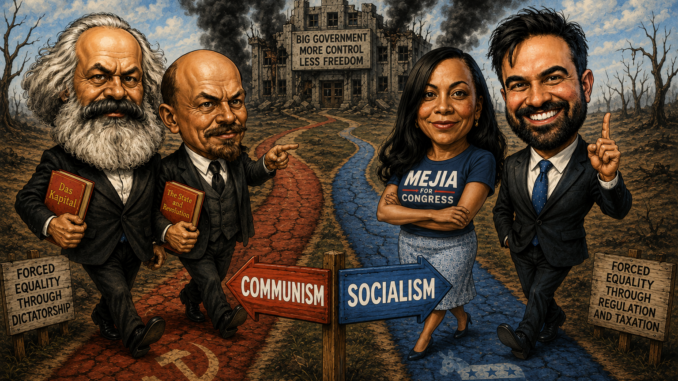
For generations, the Left has insisted there’s a bright line separating socialism from communism. Communists, we’re told, want government to seize everything. Socialists merely want government to “help people.”
It’s a comforting distinction, Save Jerseyans!
It’s also one that completely falls apart once you stop listening to campaign slogans and start watching what governments actually do.
Communism and socialism are less like two different destinations than two points on the same road. One promises to nationalize everything immediately. The other promises to get there gradually through regulation, taxation, subsidies, mandates, and public ownership. The pace differs. The destination—a society where government increasingly directs economic life—is substantially the same.
Karl Marx himself viewed socialism as a transitional stage before full communism. The historical argument over where one ends and the other begins has always mattered more to academics than to ordinary citizens trying to pay their bills.
After all, if government doesn’t technically own your business but dictates whom you may hire, what you may charge, how much you must pay employees, what benefits you must provide, what products you may sell, and what percentage of your profits it will confiscate, how much practical control do you really retain?
Ownership without control is little more than an accounting exercise.
Modern democratic socialists object that they support elections, constitutional government, and private enterprise. Fair enough. Most are not advocating Soviet-style one-party rule.
But economics tells a different story.
Every major socialist proposal—from government-run healthcare to state-directed energy policy, wealth taxes, industrial subsidies, rent control, price controls, and aggressive redistribution—moves decision-making away from millions of individuals and toward a handful of politicians and bureaucrats.
Each intervention creates distortions. Those distortions inevitably produce calls for additional intervention. A subsidy requires a regulation. The regulation requires enforcement. The enforcement requires bureaucracy. The bureaucracy demands more funding. Before long, government isn’t simply refereeing the economy; it’s calling the plays.
That’s why socialism rarely stops where its advocates promise it will.

Here in New Jersey, residents already experience this incremental model every day. Trenton doesn’t need to nationalize grocery stores to influence food prices. It doesn’t need to own power plants to dictate energy policy. It doesn’t need to seize private wealth outright when it can steadily raise taxes, expand mandates, pick winners and losers through subsidies, and grow government to record levels.
The result is a state where politicians exercise increasing influence over decisions once left to families, entrepreneurs, employers, consumers, and local communities.
Call it democratic socialism if that sounds friendlier.
The mechanism remains the same: more centralized political control over economic life.
That’s ultimately the distinction that matters.
Communism seeks total state control in a single dramatic leap. Socialism takes smaller, politically palatable steps. One uses a sprint; the other prefers a staircase.
Either way, the direction of travel is identical.
The question isn’t whether the government arrives all at once.
The question is whether Americans are willing to keep surrendering one piece of economic freedom at a time until they discover there isn’t much left to surrender.