By Josh Findlay

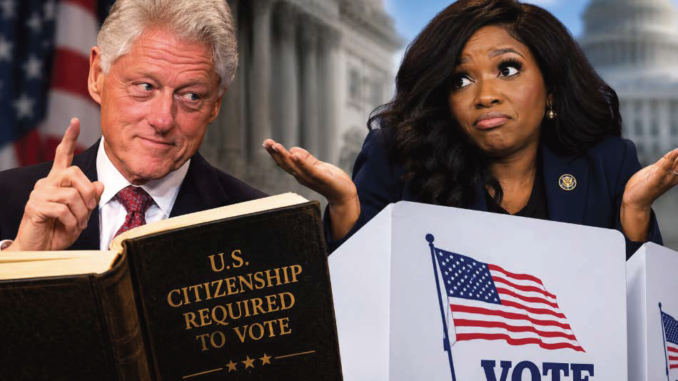
If President Bill Clinton had been sitting in last week’s House Judiciary Subcommittee on Oversight hearing on noncitizen voting, he might not have recognized his own party.
During the hearing, Texas Rep. Jasmine Crockett accused Republicans of wanting Americans to believe “there are thousands of noncitizens voting in elections.”
Crockett then noted that in “states that have conducted audits of their state elections, only seven hundred of the more than one hundred and forty million votes have been associated with noncitizens.”
I was there as a witness testifying about New Jersey, where approximately 6,600 noncitizens were registered to vote in the state, and how nearly 400 reportedly cast ballots.
Crockett was not the only Democrat to seem to dismiss the concern.
Maryland Rep. Jamie Raskin declared that “noncitizen voting is exceedingly rare.”
The contrast with Clinton could hardly be sharper.
Back in 1996, Clinton was calling for stronger enforcement of the country’s immigration laws.
“We are a nation of immigrants,” he said in February. “But we are also a nation of laws.”
Later that year, Clinton signed the Illegal Immigration Reform and Immigrant Responsibility Act, making noncitizen voting a federal crime that could lead to deportation.
Clinton’s legislation drew a line on eligibility. Either a person was eligible to vote in our elections or not.
Crockett and Raskin can try to downplay noncitizen voting all they want. The law Clinton signed did not require thousands of unlawful votes before the issue mattered. One ineligible vote was still one ineligible vote.
That is what I tried to underscore during my testimony: any vote cast by a noncitizen dilutes the vote of an American citizen.
That should not be difficult to understand.
It is voter suppression, plain and simple.
Even a small number of votes matter.
In 2025 alone, New Jersey had at least three races decided by one vote or ending in a tie.
A Mantua Township school budget referendum was decided by exactly one vote.
A Toms River fire commissioner election and an Oakland Borough Council race both ended in ties.
In 2022, Jennifer Williams won a Trenton City Council race by one vote. A hand recount found two previously uncounted ballots, but the margin remained exactly 428 to 427.
These are not hypothetical margins. These results illustrate a basic point: one vote really can determine the outcome of an election.
When a single vote can determine who takes office, an ineligible vote is not a harmless mistake. It can change the outcome and undermine public confidence in the voting process.
That is why what happened in New Jersey is so jarring. Approximately 6,600 noncitizens were registered to vote, and nearly 400 reportedly cast ballots.
Gov. Mikie Sherrill blamed the registrations on a “serious software error.”
Yet as I told the subcommittee, registering noncitizens to vote may have been a feature of the motor vehicle system rather than a software error.
The warning signs had been there for months.
This past May, Democratic State Senator Jim Beach and Republican State Senator Kristin Corrado noted that people who identified themselves as noncitizens in the state’s online driver’s license system were still being prompted to register to vote.
The senators proposed straightforward legislation: people who identify as noncitizens should not be asked to register to vote.
This should not require legislation. It should just be common sense.
A month later, the New Jersey Republican Party Election Integrity Task Force identified “hundreds of non-citizens were registered to vote,” with “at least 30 documented cases of non-citizens illegally casting votes, in some cases in multiple elections and for many years.”
Eligibility should be verified before someone is placed on the voter rolls, not after that person has registered or potentially cast a ballot.
Just three days after the hearing, the Department of Justice announced charges against 16 people for allegedly illegally voting and related election crimes. Eight of those charged were noncitizens living in Texas, the same state Crockett represents in Congress.
Bill Clinton understood what Crockett’s remarks missed. There is no acceptable number of noncitizen votes in an American election. Not a thousand. Not a hundred. Not even one.
One vote can decide the outcome of a race. That choice should belong only to American citizens.
_
Josh Findlay is the director of the Texas Public Policy Foundation’s National Election Protection Project and hosts TPPF’s “Election Protection Project Podcast.” He previously led nationwide election integrity efforts as the Republican National Committee’s national director of election integrity.