By Matt Rooney

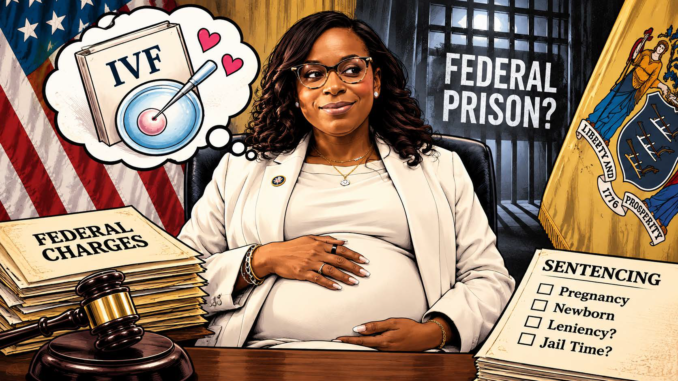
Rep. LaMonica McIver isn’t merely pregnant while facing federal criminal charges, Save Jerseyans. The New Jersey Democrat is now admitting that she made a conscious decision to try to become pregnant while she knew the case could result in prison time.
That is one of the more striking statements in a first-person essay published by ELLE.
“People might find it crazy that even though I’m facing 17 years in prison, I made the decision to try IVF one more time and get pregnant,” McIver told the publication.
McIver explained that she had one remaining embryo following years of fertility struggles and multiple surgeries, and decided she was not going to let her criminal case prevent her from trying again.
“After I recovered, we started IVF again,” she wrote. “I was crossing my fingers because it was the last embryo. And it worked.” McIver said she was 33 weeks pregnant when the essay was written and hoped to deliver in October.
That timeline matters, although the essay does not pin her IVF decision to a specific date in the prosecution.
McIver was indicted in June 2025 on three federal counts arising from the May 9, 2025 confrontation at Newark’s Delaney Hall immigration detention facility. Prosecutors allege that she interfered with officers attempting to arrest Newark Mayor Ras Baraka, made forcible contact with one officer and struck another with her forearms. McIver has pleaded not guilty and disputes the government’s characterization of the encounter. The statutory maximum penalties on the three counts add up to 17 years. That is the maximum possible exposure if all three counts result in convictions, not a prediction of the sentence she would receive.
McIver’s challenge to the prosecution has had mixed results. In August, a divided Third Circuit panel rejected her legislative-immunity argument as to Counts One and Two, allowing those charges to proceed. It sent Count Three back to the district court for further consideration. The panel also declined to review her selective- and vindictive-prosecution claims at this stage because it lacked jurisdiction over that part of the appeal; it did not decide those claims on the merits.
So here is a question raised by McIver’s circumstances:
Could being pregnant—or having recently delivered a baby—help her avoid prison if she is convicted?
The short answer is that pregnancy is not a get-out-of-jail-free card.
At sentencing, federal law requires a judge to consider the defendant’s “history and characteristics,” along with the seriousness of the offense, deterrence, available sentences and other factors. A judge could consider pregnancy, postpartum medical needs and the effect of incarceration on a newborn and McIver’s existing child. None of those circumstances automatically prevents incarceration.
The U.S. Sentencing Commission’s 2025 guidelines amendment removed the former specific-offender-characteristic departure provisions. The Commission described the change as “outcome neutral”: it did not prevent judges from considering relevant personal circumstances when deciding whether a sentence outside the advisory guideline range is appropriate.
An older federal appellate decision illustrates both the limits of a pregnancy-based argument and the need for care in describing the law. In United States v. Pozzy, 902 F.2d 133 (1st Cir. 1990), the First Circuit reversed a downward departure based partly on the defendant’s pregnancy. The court said pregnancy among convicted defendants was not necessarily unusual, noted that the Bureau of Prisons had experience caring for pregnant inmates, and observed that the sentencing judge could have postponed the start of imprisonment until after delivery.
But Pozzy is a First Circuit case decided under the sentencing guidelines as they operated in 1990. It is not a controlling Third Circuit decision on how a judge should evaluate a pregnancy-related request today. The court also expressly stopped short of saying pregnancy could never be a sentencing consideration.
Federal prison policy likewise contemplates that pregnant women can be incarcerated. The Bureau of Prisons’ policy provides for medical and counseling services and calls for childbirth at a hospital outside the institution. Federal law sharply restricts the use of restraints from confirmation of pregnancy through postpartum recovery, subject to limited exceptions.
The BOP also operates a Mothers and Infants Together, or MINT, program. Eligible pregnant inmates may spend the final two months of pregnancy at a residential reentry center and remain there for up to three months after giving birth before returning to prison. Eligibility is not automatic.
In other words, the federal system has ways to address pregnancy during incarceration. Those policies do not determine whether McIver would receive a prison sentence—or, if she did, when it would begin.
What makes McIver’s account noteworthy is that she does not describe an unexpected pregnancy that happened to coincide with a prosecution. She says that, aware of the criminal case and possible prison exposure, she chose to pursue another IVF attempt.
That was McIver’s personal decision. Whether her pregnancy or family circumstances would affect a sentence is a separate question for a federal judge, and one that would arise only if she were convicted.
For now, McIver remains presumed innocent (although the video is pretty darn incriminating). The “17 years” cited in coverage is the combined statutory maximum, not an estimate of what she would serve.
If the case reaches sentencing, her lawyers could ask a judge to consider her medical condition and the needs of her children. Prosecutors might respond by pointing to her account of choosing to pursue IVF after the case began. But there is no rule that a planned pregnancy loses its relevance at sentencing, just as there is no rule that pregnancy prevents imprisonment.
McIver’s essay makes clear that she understood the possibility of prison when she decided to try to become pregnant. What legal significance, if any, that decision would have remains uncertain.