
By Matt Rooney

Here’s a political reality that gets surprisingly little attention, Save Jerseyans: you don’t need to cast a ballot to affect the balance of power in Congress.
You just need to be counted.
The census includes illegal immigrants when determining congressional representation. Their presence therefore contributes to both a state’s share of House seats and the population used to draw individual districts. That’s how the system works, regardless of whether those residents can legally vote.
So here’s the thought experiment: What would happen to New Jersey’s congressional map if its entire illegal immigrant population left the state?
Potentially, quite a lot.
And the Trump administration is pursuing another way to change the equation: excluding illegal immigrants from the count used to allocate congressional seats.
On September 10th, the Census Bureau published a proposed rule that would do precisely that. The proposal goes further, also excluding foreign citizens whose immigration status falls short of lawful permanent residency. American citizens and green-card holders would remain included. It is still a proposal, with public comments due October 13—not a change already in effect.
The administration argues that physical presence alone does not establish the enduring ties necessary to count toward representation. Opponents point to the Fourteenth Amendment’s requirement to count the “whole number of persons in each State.” Expect a major legal fight.
For New Jersey, that creates two potential paths to reduced representation: actual population losses following deportations, or a narrower apportionment count even if those residents remain here. Excluding people from the interstate allocation of House seats would not, by itself, settle how populations are counted when drawing districts within New Jersey.
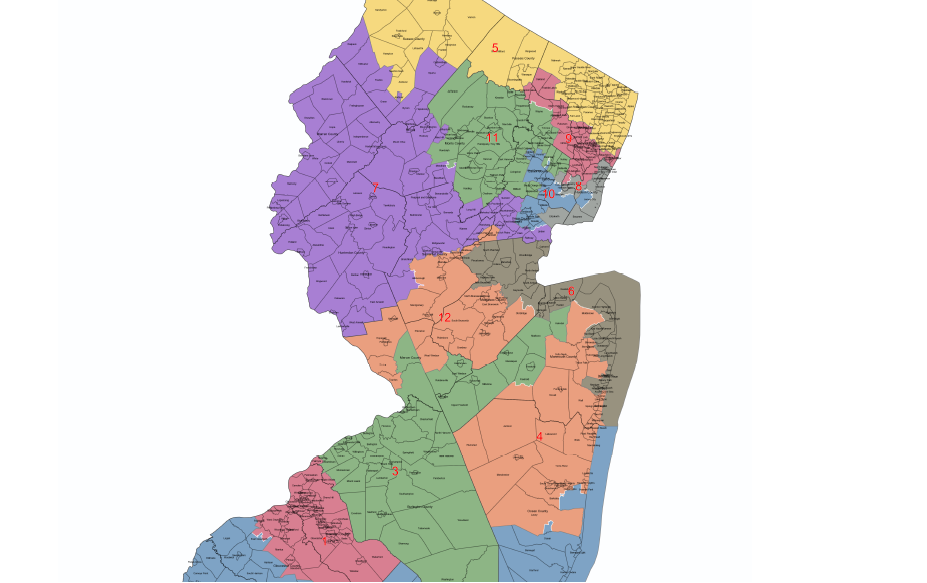 But either path raises a question Trenton cannot ignore: How much congressional clout depends on residents who are here illegally?
Pew Research Center estimated that New Jersey had approximately 600,000 unauthorized immigrants in 2023. That’s a dated estimate, not a live deportation roster; Pew’s definition also includes some people with temporary protection from removal. It does, however, provide a helpful jumping off point for examining the scale.
Take the official 2020 apportionment figures. Subtract 600,000 residents from New Jersey alone. Hold every other state’s population constant and rerun the federal formula.
New Jersey falls from 12 House seats to 11. New York picks up the displaced seat.
That is the result of an illustrative calculation using Census Bureau data—not a forecast for 2030 or a model of Trump’s proposal. Nationwide removals or exclusions would require adjusting every state’s population, potentially producing a different result. Population growth between censuses matters, too.
Still, the hypothetical reveals the stakes: a population change of that magnitude can be large enough to cost New Jersey an entire congressional district.
And that’s where the political knife fight begins.
Losing a seat wouldn’t mean simply erasing a district number. Eleven districts would need to accommodate the population used for redistricting. Incumbents could find themselves competing for the same seat, and municipalities could be shifted through several neighboring districts.
Even if New Jersey retained all 12 seats, uneven population losses from departures would require adjustments at the next redraw.
Where might the pressure show up?
North Jersey would be the first region to examine. The Hudson–Elizabeth corridor associated with the 8th District and the Paterson–Passaic area associated with the 9th would be obvious places to investigate using local unauthorized-population estimates. Changes there could ripple through neighboring districts in Bergen, Essex and Union counties. The official map shows how closely those districts fit together. This is a geographic hypothesis, however—not a district-level population finding.
If those districts lost disproportionately large shares of their residents, they would need additional territory. Depending on the boundaries, that could mean taking in more suburban voters and changing the political complexion of adjoining seats.
The Republican opportunity would probably be less about turning a Newark-centered district red than about reshuffling the suburban territory surrounding Democratic strongholds.
But there’s a catch: expanding a Democratic district into Republican suburbs can also remove Republican voters from the district next door. A redraw can help the GOP in one place while hurting it somewhere else.
What could an 11-seat delegation look like? Here are three illustrative political scenarios, not modeled election forecasts:
| Hypothetical split | What would have to happen |
|---|---|
| 8 Democrats–3 Republicans | Democrats absorb the lost seat while Republicans preserve three winning districts. |
| 7 Democrats–4 Republicans | The redraw preserves three Republican districts and creates an additional GOP opportunity in the suburbs. |
| 6 Democrats–5 Republicans | A substantially more favorable suburban map combines with strong Republican election performance. This requires considerably more than population loss alone. |
An 8–3 outcome is easy to envision. A 7–4 outcome is a possibility worth exploring. Calling 6–5 the likely result would be getting well ahead of the evidence. These scenarios also do not exhaust the possibilities; Republicans could lose ground under an unfavorable redraw.
Republicans don’t get to draw the lines unilaterally. New Jersey’s congressional redistricting commission has six members from each major party and a thirteenth, independent member. The final map would emerge from that process.
The serious argument is powerful enough without embellishment: illegal immigration affects congressional representation even when no illegal ballot is cast.
Trump’s census proposal puts that issue directly on the table. Deportations could change the underlying population. Either could alter New Jersey’s congressional arithmetic—but whether Republicans capitalize on the resulting map would still depend on winning the voters who remain.