By Matt Rooney

New Jersey Democrats are once again trying to solve a problem that largely doesn’t exist — while dramatically expanding the power of courts, bureaucrats, and politically-compromised state officials in the process.
On Thursday, the Senate Judiciary Committee advanced the “John Lewis Voter Empowerment Act” by a 7-2 margin, pushing the controversial election overhaul another step forward after it had already cleared the Assembly.
Advocates frame the measure as a safeguard of voting rights. But beneath the lofty rhetoric lies a sweeping restructuring of how elections could be administered in the Garden State.
Let’s say it more plainly: it’s about to get much easier to rig elections.
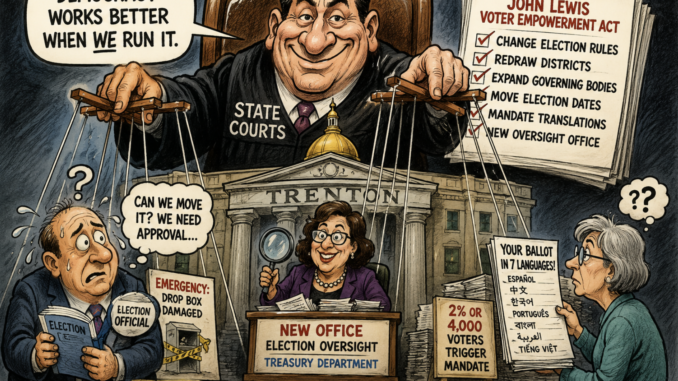
I’m not being dramatic, Save Jerseyans. The legislation would hand state courts unprecedented authority over election procedures. Judges could intervene to alter election practices deemed “inconsistent” with the law, redraw district boundaries, enlarge governing bodies, and even shift certain local elections onto higher-turnout state or federal election dates… all without a single vote of the legislature or the electorate.
If a campaign, for example, is accused of including a racist “dog whistle” in an ad or a mailer? A Superior Court judge could theoretically throw out an election result.
That should concern anyone who believes election rules ought to be set by elected representatives accountable to voters — not by judges operating under broad and often subjective legal standards.
The proposal also imposes new language-access mandates on local governments. Municipalities and counties would be required to provide translated election materials whenever a relatively small threshold of residents speaks another language and has limited English proficiency. Regardless of where one stands philosophically, there’s no denying the measure creates another costly administrative burden for local governments already squeezed by mandates from Trenton. Once again, you’re the one paying for Democrats’ GOTV program.
And, naturally, the bill creates yet another government entity. They can’t help themselves!
A newly established office within the Treasury Department would oversee cases involving alleged limitations on the voting influence of racial or language minority groups. Trenton’s answer to every issue, it seems, is another layer of bureaucracy staffed by unelected officials with vague but expansive authority.
The bucket of additional concerns is overflowing: the likelihood of increased litigation, uncertainty surrounding emergency election changes, and the possibility that ordinary election administration disputes could become tied up in lengthy legal battles. Those aren’t partisan talking points — they’re practical concerns from people who actually administer elections.
Divorced from reality but tethered to their agenda, activists backing the bill continue to invoke apocalyptic language about democracy itself being under threat.
That’s become the modern progressive playbook: declare an existential crisis, centralize authority, and dismiss skepticism as extremism. They’re on the brink of implementing a system where courts, state agencies, and permanent bureaucracies exert greater influence over election administration than ever before in state history.
New Jersey already offers expansive voting access through mail-in ballots, early voting, and numerous anti-discrimination protections. Do you have a pulse? You can vote. This bill doesn’t ”protect voting rights” or safeguard any citizen’s imperiled rights; it fundamentally shifts control of elections away from local communities and toward an unaccountable establishment.
And once the government acquires that kind of authority, history suggests it rarely gives it back.