By Matt Rooney

New Jersey’s FY2027 budget—Assembly Bill A5327, which Governor Sherrill signed on Tuesday evening—is once again being sold as a sober exercise in fiscal stewardship. At roughly $91 billion when federal dollars are included, it certainly has the scale of a serious governing document. But as always in Trenton, the real story isn’t just the topline number—it’s what gets tucked inside the margins when nobody is looking too closely.
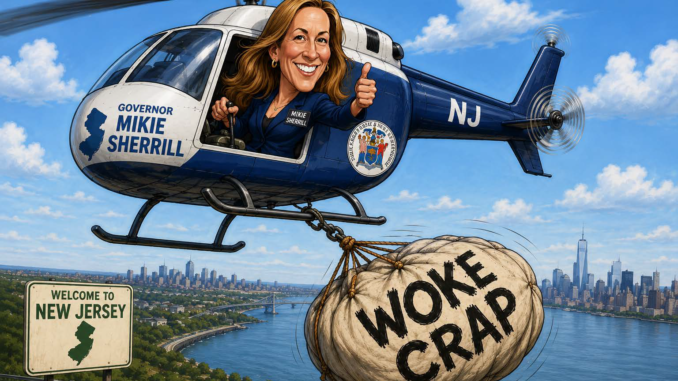
And in those margins, a familiar pattern emerges: a constellation of “equity,” “climate,” and identity-based programs that critics would reasonably describe as the state’s ongoing devotion to ideological budgeting.
Start with the Reproductive Health Access Fund, funded at $22 million. Supporters frame it as expanded access to reproductive healthcare and clinic security. But in practice, it underwrites the larger infrastructure surrounding abortion access, from provider training to facility protection grants. Whatever label Trenton prefers, it is unmistakably one of the largest explicit policy-driven carveouts in the budget. Should we be paying for someone else’s abortion when we’re grappling with a massive structural deficit?
Then there’s the DEI apparatus—no longer confined to a single office, but now embedded across multiple agencies like a permanent feature of state government.
The Office of State Diversity, Equity, and Inclusion receives $850,000 through the Division of Management and Budget. Meanwhile, the Treasury Department maintains a Chief Diversity Officer position carrying a price tag of $1.237 million. Add another $500,000 for Minority and Women Business Enterprise programs—initiatives that explicitly prioritize procurement based on race and gender classifications—and the architecture of equity bureaucracy becomes clear.
Climate programming follows a similar pattern. The Office of Climate Action and the Green Economy in the Department of Environmental Protection receives $500,000, while Climate Change Education Grants direct another $500,000 into school-based instruction programs centered on climate policy framing. These are not neutral infrastructure investments; they are curriculum and messaging pipelines funded by taxpayers.
Smaller line items reinforce the same ideological footprint. A $950,000 allocation supports an LGBTQ-focused community health center. The Department of Corrections receives $250,000 for diversity training programs. A Perinatal Health Equity Initiative—explicitly targeting racial disparities in maternal outcomes—receives $50,000. Language access services add another $1 million, while the Office of New Americans also receives $1 million to support immigrant integration programming.
Even cannabis regulation contains embedded “social equity” provisions designed to steer economic opportunity toward designated groups. And a Council on Gender Parity, funded through workforce initiatives, rounds out the list of identity-focused spending priorities.
Individually, the items are raindrops in a much bigger sea of reckless budgeting. But that misses the point.
Budgets are not just accounting documents—they are value statements. And what New Jersey’s FY2027 spending plan signals, once again, is that Trenton has fully normalized the idea that government should be actively structured around identity categories, behavioral outcomes, and contested social priorities.
Supporters of these programs will argue they exist to correct disparities, expand inclusion, and prepare the state for long-term challenges including climate change and societal health inequities. You and I are clear-eyed, Save Jerseyans, and we see the FY 2027 budget for what it is: an extensive and corrupted administrative ecosystem built around political ideology rather than core government functions.