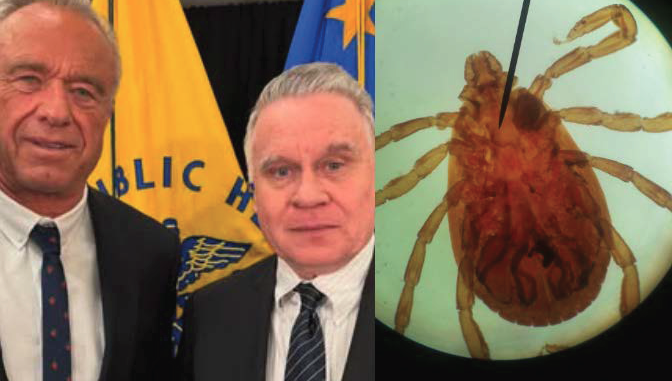
WASHINGTON, D.C. — New Jersey Congressman Chris Smith (R, NJ-04) is welcoming a series of new federal initiatives aimed at strengthening the nation’s response to Lyme disease, including expanded research funding, prevention efforts, and support for innovative diagnostic tools.

On Friday, Secretary Robert F. Kennedy Jr. announced an initiative by the U.S. Department of Health and Human Services to increase federal investment in combating Lyme disease and other tick-borne illnesses. The initiative includes support for reauthorizing the Kay Hagan Tick Act, a law that provides funding for research and prevention programs through the Centers for Disease Control and Prevention.
Smith, who co-chairs the Congressional Lyme and Tick-Borne Disease Caucus, is sponsoring legislation (H.R. 4348) designed to extend funding and expand federal-state cooperation to combat tick-borne disease outbreaks. The legislation passed through the House Energy and Commerce Committee unanimously.
In a statement, Smith said Kennedy’s endorsement could help accelerate congressional action as the summer tick season begins. Health officials have reported increasing concerns about tick exposure and Lyme disease cases in several regions of the country.
Kennedy also announced an expansion of the LymeX Innovation Accelerator, a public-private partnership that funds competitions designed to spur advancements in Lyme disease prevention, diagnosis, and treatment. According to Smith, the program has already contributed to the development of two FDA-approved diagnostic tests intended to improve early detection of the disease.
“Millions of Americans battling Lyme disease and other tick-borne illnesses have spent years searching for answers, treatment, and support,” said Secretary Kennedy. “Today, the Trump Administration is launching one of the most ambitious federal efforts ever to combat Lyme disease by accelerating research, expanding innovation, and improving care for patients and families. We are going after this disease at its source, driving faster diagnostics and new prevention strategies, and delivering the urgency and action Americans deserve.”
The congressman has separately introduced legislation that would formally authorize the LymeX program and provide additional federal funding to support future research competitions.
Another component of the federal initiative focuses on reducing tick populations and limiting the spread of Lyme-causing bacteria among wildlife. HHS plans to work with the New England Center of Excellence in Vector-Borne Diseases on strategies to control infection rates in animals such as deer and mice, which play a role in the disease’s transmission cycle.
Smith noted that the research center was established through funding authorized by the original Kay Hagan Tick Act and has contributed to ongoing efforts to better understand tick-borne diseases and effective prevention methods.
Lyme disease is the most frequently reported vector-borne illness in the United States. Federal officials say expanding research, improving early detection, and developing new prevention strategies will be key components of a broader effort to reduce infections and improve patient outcomes nationwide.