By Matt Rooney

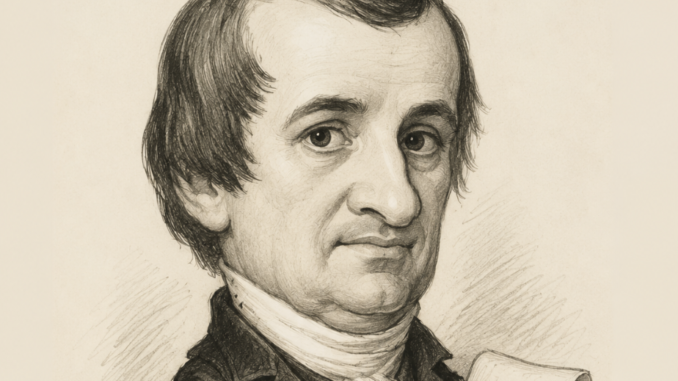
Meet Abraham Clark, one of the men who made 250 possible.
Born on February 15, 1726, in Elizabethtown (today’s Elizabeth) and raised in what is now Roselle, Clark was never the flashy revolutionary. He wasn’t a military commander like George Washington or a world-famous intellectual like Thomas Jefferson. Instead, he represented something just as important: the ordinary American whose integrity and perseverance helped make independence possible.
Largely self-educated, Clark received little formal schooling but possessed an insatiable appetite for learning. While earning a living as a surveyor, he taught himself mathematics, astronomy, and the law. His surveying work took him across colonial New Jersey, exposing him to the struggles of ordinary farmers and landowners. Those experiences shaped the man he would become.
He eventually became a successful attorney, but unlike many lawyers of his era, Clark earned the nickname “the poor man’s counselor.” He frequently represented struggling New Jersey farmers and impoverished residents who couldn’t afford legal representation, and he often expected little or nothing in return. Unlike many of his fellow Founding Fathers, Clark wasn’t born into immense wealth. He built his career through diligence, intellect, and a genuine commitment to justice, making him one of the most relatable members of the Continental Congress.
Public service came naturally to him. After marrying Sarah Hatfield and raising an astonishing ten children, Clark served in numerous colonial offices, including High Sheriff of Essex County. His reputation for honesty, intelligence, and fairness made him one of New Jersey’s most trusted public servants.
As tensions with Great Britain escalated, Clark became deeply involved in the Patriot cause. He served on New Jersey’s Committee of Safety, helping organize the colony’s revolutionary government as royal authority crumbled. These committees coordinated militia activities, secured military supplies, maintained public order, and monitored Loyalist activity. It wasn’t glamorous work, but it was indispensable. Long before he signed the Declaration of Independence, Clark had already committed himself to the cause of American liberty.
Ironically, New Jersey wasn’t initially eager to declare independence.
In fact, as late as the spring of 1776, New Jersey’s delegates to the Continental Congress opposed breaking from Great Britain. The colony truly was the crossroads of the American Revolution—not only geographically, but politically. Loyalists and patriots lived side by side, and public opinion remained deeply divided.
Everything changed after Royal Governor William Franklin—the loyalist son of Benjamin Franklin—was arrested and removed from power. New Jersey selected an entirely new congressional delegation committed to independence.
Abraham Clark was among them.
On June 28, 1776, Clark arrived in Philadelphia alongside fellow New Jersey delegates John Hart, Francis Hopkinson, Richard Stockton, and John Witherspoon. Just days later, they would help make history by voting for independence and signing the Declaration that forever changed the world.
But signing the Declaration wasn’t a symbolic gesture.
To the British Crown, it was treason punishable by death.
During the Revolutionary War, Clark served continuously in the Continental Congress until 1783. While Washington and his soldiers fought on the battlefield, Clark labored in committee rooms helping keep the fragile American government alive. He worked on military supply, finance, and the countless administrative challenges of sustaining a revolution against the world’s greatest military power. It was often thankless work, but without men like Clark, there would have been no government left for Washington’s army to defend.
The cost of independence became painfully personal.
Two of Clark’s sons enlisted in the Continental Army and were eventually captured by British forces. They were imprisoned aboard the notorious prison ship H.M.S. Jersey, where thousands of American prisoners died from disease, starvation, abuse, and neglect. Because their father had signed the Declaration of Independence, British authorities reportedly singled them out for especially harsh treatment.
Clark was presented with an impossible choice.
If he publicly renounced the Declaration and his support for independence, his sons would be released.
Imagine the temptation.
Imagine the anguish.
He refused.
No parent could make that decision lightly, yet Clark believed surrendering the cause of liberty would betray not only his country but also the sacrifice his sons had already made. Miraculously, both survived captivity, though thousands of other Americans perished aboard British prison ships during the Revolution.
After independence, Clark continued serving both New Jersey and the young United States in public office. Although persistent health problems prevented him from attending the 1787 Constitutional Convention in Philadelphia, New Jersey voters continued to place their trust in him. He served in the First and Second United States Congresses under the newly ratified Constitution, helping establish the institutions of the new federal government.
Clark also advocated ideas that were ahead of their time. Under the Articles of Confederation, each state had one vote regardless of population. Clark argued that representation should reflect the number of people being represented, a principle that would ultimately become a cornerstone of the House of Representatives.
In 1794, while working on his farm in Roselle, Abraham Clark died of sunstroke at the age of 68.
Today, Clark Township and Abraham Clark High School bear his name, but too few New Jerseyans know the remarkable story behind either. His remains rest quietly in Rahway Cemetery, a fittingly humble resting place for a man who never sought personal glory.
Abraham Clark wasn’t the most famous of the Founders. He wasn’t the wealthiest, the greatest writer, or the best-known statesman. He was something equally indispensable: a citizen who believed liberty was worth personal sacrifice. He built his own success through hard work, defended those who couldn’t defend themselves, helped launch a revolution, endured unimaginable suffering as a father, and never wavered when the price of freedom became painfully personal.
The American Revolution wasn’t won solely by giants like Washington, Jefferson, or Franklin. It was also won by steady, principled men like Abraham Clark—citizens whose quiet courage proved every bit as essential to the birth of the Republic. Two hundred and fifty years later, New Jersey should proudly remember one of its greatest sons.