By Matt Rooney

John Hart didn’t live long enough to see the ultimate American victory at Yorktown or the formal recognition of American independence in the Treaty of Paris. He died in 1779 on his Hopewell Township farm after years of public service and personal sacrifice for the revolutionary cause.
Hart was born around 1713 in what was then Maidenhead Township in Hunterdon County (today’s Mercer County). The son of Edward Hart, an early settler and prosperous farmer, John grew up in colonial New Jersey at a time when the province was still developing from scattered agricultural settlements into a thriving colony. Like many of the Founding Fathers, he never received a formal college education. Instead, he built his reputation through hard work, sound judgment, and unwavering integrity.
He became one of Hunterdon County’s most respected farmers and landowners while raising thirteen children with his wife, Deborah Scudder Hart. Tragically, Deborah died in 1776—the same historic year her husband signed the Declaration of Independence—leaving Hart to balance family responsibilities with the demands of revolution.
Long before independence became imaginable, Hart established himself as one of colonial New Jersey’s most trusted public servants. He served on the Hunterdon County Board of Chosen Freeholders (remember, Mercer County would not be created until 1838) before winning election to New Jersey’s colonial Assembly. His honesty and fairness earned him an appointment as a justice of the Court of Common Pleas, where his sterling reputation inspired the nickname “Honest John”—an honor few contemporary New Jersey politicians could realistically aspire to.
Like many moderate colonial leaders, Hart did not begin his political career as a revolutionary firebrand. For years, he sought reconciliation between Great Britain and her American colonies. Only after repeated abuses by Parliament and King George III convinced him that colonial liberties could no longer be preserved did Hart embrace independence. Once he reached that conclusion, however, his commitment never wavered.
The year 1776 transformed both Hart’s life and world history. He was elected to New Jersey’s Provincial Congress, the revolutionary body that replaced the royal government after Governor William Franklin—the king’s loyalist son of Benjamin Franklin—was arrested and removed from power. That Congress instructed New Jersey’s delegates to support independence, prompting Hart to sign the Declaration of Independence on behalf of the Garden State.
His responsibilities hardly ended there. Hart became Vice President of New Jersey’s revolutionary government, served on the influential Council of Safety—which exercised broad executive authority while the Legislature was out of session—and eventually became Speaker of the brand-new New Jersey General Assembly. Throughout the darkest days of the Revolution, Hart helped keep New Jersey’s government functioning while British armies repeatedly marched across the state.
Those invasions carried a deeply personal cost.
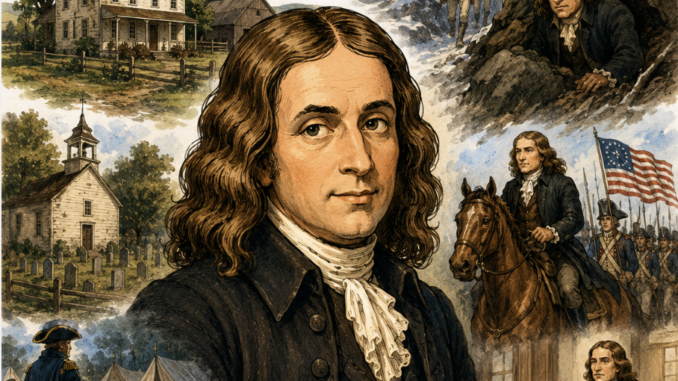
When British and Hessian forces swept through Hunterdon County during the disastrous New York campaign in December 1776, Speaker Hart became a hunted man. British troops reportedly sought to capture one of New Jersey’s leading revolutionaries, forcing the 63-year-old patriot to flee into the rugged Sourland Mountains. He spent days hiding in caves, forests, and among sympathetic neighbors while enemy soldiers occupied and looted his property. His farm was raided, his livestock stolen, and his family scattered for safety.
Only after General George Washington’s stunning Christmas night crossing of the Delaware River and his victory at Trenton were the British driven from the area. Hart returned home on December 26 to find his farm damaged but his resolve unbroken.
His commitment to the American cause remained steadfast. In June 1778, as Washington maneuvered his army toward what would become the Battle of Monmouth, Hart voluntarily opened his farm to approximately 12,000 Continental soldiers. His property served as an encampment and staging area for one of the largest troop movements of the Revolutionary War in New Jersey.
Hart’s signature also became familiar to ordinary Americans in another way. Like many revolutionary leaders, he signed large quantities of colonial paper currency, helping to finance the war effort despite the rapidly depreciating value of Continental money. Surviving notes bearing his distinctive signature remain prized historical artifacts today.
The burdens of public service and war eventually became too much to bear. Advanced age, years of relentless work, and painful recurring kidney stones—then commonly called “gravel”—forced Hart to retire from public life on November 7, 1778. He survived only six more months, dying on May 11, 1779, at approximately 65 years of age.
Before his death, Hart donated a portion of his Hopewell farm to the local Baptist congregation, which constructed the Old Baptist Meeting House on the property. He was buried there, and visitors can still pay their respects at the historic cemetery today. Much of the surrounding farmland has been preserved as the John Hart Heritage Area, allowing modern visitors to experience a landscape remarkably similar to the one Hart himself knew during the Revolution.
His May 19, 1779, obituary in the New Jersey Gazette was worthy of Hart’s life well lived:
On Tuesday the 11th instant, departed this life at his seat in Hopewell, JOHN HART, Esq., the Representative in General Assembly for the county of Hunterdon, and late Speaker of that House. He had served in the Assembly for many years under the former government, taken an early and active part in the present revolution, and continued to the day he was seized with his last illness to discharge