By Matt Rooney

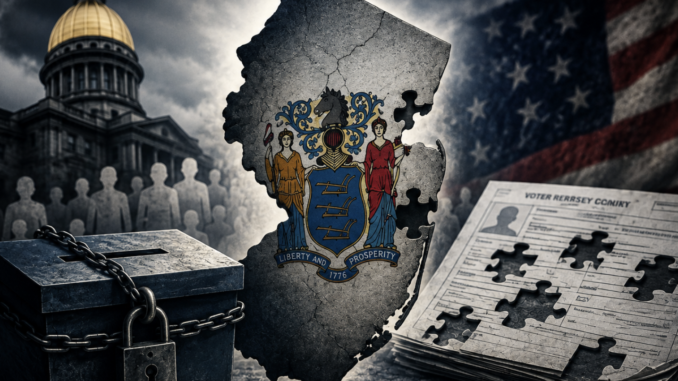
If you’re just tuning into New Jersey’s voter registration scandal, Save Jerseyans, it’s easy to think the story began when Governor Mikie Sherrill announced that more than 6,600 non-citizens had been improperly registered to vote.
It didn’t.
The scandal is the product of years of deliberate policy decisions, missed warning signs, and troubling unanswered questions. Here’s the timeline every New Jerseyan should know:
1. 2018: Automatic Voter Registration Becomes Law
Governor Phil Murphy signs New Jersey’s automatic voter registration law, shifting voter registration into the Motor Vehicle Commission. Supporters call it “modernization.” Critics warn that a flawed bureaucracy can now create flawed voter rolls on a massive scale.
2. 2019: Undocumented Immigrants Become Eligible for Driver’s Licenses
Murphy signs legislation allowing undocumented immigrants to obtain New Jersey driver’s licenses. The law does not authorize voting—but it dramatically expands the number of non-citizens interacting with the same MVC system that processes voter registrations without appropriate safeguards.
3. 2023-2024: More Than 6,600 Non-Citizens End Up Registered
State officials now acknowledge that between June 2023 and June 2024, approximately 6,600 individuals who identified themselves as non-citizens nevertheless wound up registered to vote.
This wasn’t one mistaken registration.
It was thousands… that they’ve admitted to?
4. About 400 Noncitizen Ballots Are Confirmed Cast
The state has also acknowledged that around 400 of those improperly registered individuals also cast ballots before the registrations were identified.
Whether any of those votes affected election outcomes remains unknown. One Assembly race during this period was decided by less than 60 votes.
In which elections were those ballots cast, and has every affected race been identified?
5. The Public Doesn’t Learn About It Until 2026
Back to present day where Governor Mikie Sherrill publicly reveals the scandal years after the registrations occurred.
By now, multiple election cycles have already come and gone with a compromised system in place.
Who first discovered the “glitch,” and when? Did they never bother to investigate/audit/review the system until the DHS asked? Or did someone know but choose not to reveal the problem – or one facet of a larger problem – until DHS asked?
6. Trenton Resists Federal Scrutiny
Rather than opening the books, the Sherrill administration declines to provide requested voter-registration records to the Department of Homeland Security, arguing that privacy laws limit disclosure.
Critics argue that transparency—not secrecy—is the only way to restore public confidence.
If the state is confident in its response, why fight outside review?
7. Sherrill Opposes the SAVE Act
As Congress debates requiring documentary proof of citizenship when registering to vote, Sherrill dismisses the proposal as “voter suppression” while expressing openness to voter ID during a News12 interview.
8. A $20 Million Legal Defense Fund Raises New Questions
Meanwhile, as the voter registration controversy continues, the Sherrill administration also launches a $20 million legal defense fund – bankrolled by taxpayers – to provide legal assistance for certain non-citizens facing immigration proceedings.
To many New Jersey taxpayers, the optics are hard to ignore: the state is spending millions defending non-citizens while still struggling to fully explain how thousands of them ended up on the voter rolls in the first place.
The Bottom Line
Think about what New Jersey officials are asking the public to believe. A system that automatically registered voters, accepted data from non-citizens applying for driver’s licenses, and allegedly allowed thousands of ineligible registrations somehow operated for years without anyone noticing—until the federal government came calling.
That strains credulity.
A process built with virtually no meaningful verification and no apparent mechanism (or effort?) to flag obvious eligibility problems isn’t merely a system that failed. It’s a process designed to produce fraudulent registrations. Whether any particular official intended that outcome is a separate question, but the predictable result of such a system was always going to be ineligible voters ending up on the rolls.
That raises obvious questions investigators should answer. Were routine audits ever conducted? If not, why not? If audits were performed, what did they show? Who reviewed those findings?
And if warning signs appeared before DHS became involved, who decided the public didn’t need to know?
Whether the truth is bureaucratic indifference or deliberate concealment, neither explanation inspires confidence. One suggests astonishing incompetence. The other suggests officials knowingly allowed a flawed system to continue operating in silence.
Either way, New Jersey deserves accountability at the end of this damning timeline.