By Marie Tasy

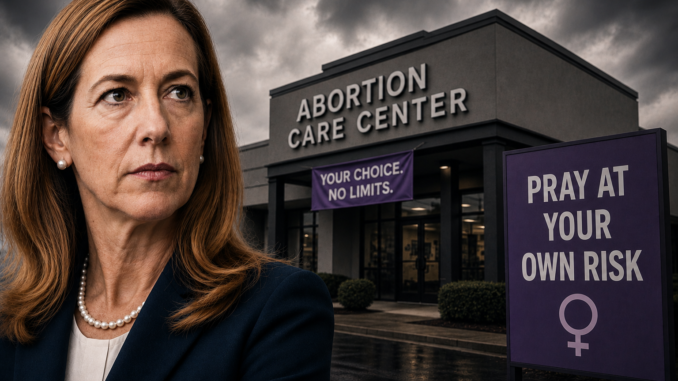
Last week in New Jersey, Governor Mikie Sherrill signed legislation that further entrenches abortion in state law, and made certain the cameras were rolling as she did it.
She stood outside Planned Parenthood in Montclair, flanked by abortion advocates, lawmakers, and activist groups, and signed the most expansive abortion shield law in the state’s history. The measure, S2260/A2218, now P.L. 2026, c. 74, bars New Jersey officials from arresting someone, issuing subpoenas or search warrants, authorizing wiretaps, or extraditing a person based on conduct that is legal here but criminal in another state. It also creates a new offense, “interference with reproductive health care services,” carrying both criminal and civil penalties.
The bill’s supporters describe it as covering reproductive and gender-affirming care alike, and it’s worth saying plainly: this law does both. But it is the abortion provisions that carry the deepest consequences, because they are designed specifically to put New Jersey’s legal machinery between other states and the enforcement of their own laws protecting unborn children.
Sherrill called it New Jersey “standing firm in defense of reproductive freedoms.” Freedom for whom? Not for the child in the womb. Not for the women, parents, and legislatures of other states whose laws New Jersey has deliberately set out to undermine. Not for pro-life citizens exercising their First Amendment rights. Instead, it is freedom for an industry that preys on women at a vulnerable time in their lives and profits from ending the lives of children whose hearts are already beating.
This was not a first appearance. Four years ago, as a member of Congress, Sherrill showed up at this same Planned Parenthood after the draft Supreme Court opinion overturning Roe leaked. This week she returned with the full power of the state behind her.
A pattern, not an accident
Since taking office in January, Sherrill has methodically built a legal and financial fortress around the abortion industry:
Her first budget directed $52 million of New Jersey taxpayers’ money, including from families with profound moral objections to abortion, to abortion providers and related programs.
Less than six months later, she signed a law shielding those same providers from accountability when they violate the laws of other states.
She belongs to the Reproductive Freedom Alliance, a coalition of governors that shares legal strategy and model legislation across state lines. New Jersey is not merely protecting its own abortion industry; it is helping export the tools to protect the industry everywhere.
Sherrill frames these actions as a response to “attacks from the Trump Administration and other states.” But she controls the executive branch. Her Attorney General answers to her. Her party holds both chambers of the Legislature. No one is forcing her hand. Every dollar spent, every bill signed, every photo opportunity outside Planned Parenthood is a calculated decision, and one with an audience beyond New Jersey. She has not finished her first year in office, yet she has already launched a federal PAC to bankroll candidates nationally and, the same week she signed this bill, traveled to New Hampshire, the state that votes first in presidential primaries.
Convenient timing
The timing of the signing deserves scrutiny on its own terms. For weeks, Sherrill has been under fire over a state software error that improperly registered roughly 6,600 people who had indicated they were not U.S. citizens, a scandal that goes to the integrity of New Jersey’s elections. In the middle of that story, she staged a bill signing at Planned Parenthood, surrounded by cheering advocates, and stepped into the role of national face of “reproductive freedom.” Governors don’t choose their venues by accident. Whether or not it was staged to change the subject, it had exactly that effect.
What “interference” actually means
The law makes it a crime to purposely or knowingly inflict, or attempt to inflict, bodily injury on another person with the purpose of unlawfully restricting someone’s access to, or the receipt or provision of, reproductive health care services, or to intimidate a person from becoming a patient, provider, volunteer, or assistant of such services, so long as the conduct would cause a reasonable person to be intimidated. It also covers anyone who physically obstructs access to a facility, or who, by force or threat of force, intimidates, threatens, or coerces, or attempts to intimidate, threaten, or coerce, any person or entity in connection with reproductive health care services.
Supporters say this simply codifies protections against violence and obstruction. New Jersey already has statutes on the books covering assault, harassment, criminal mischief, and obstruction, regardless of where they occur or who the victim is. S2260 doesn’t protect New Jerseyans from violence they weren’t already protected from. It creates a brand-new crime aimed specifically at reproductive care, one that punishes people for making someone else feel intimidated, whether or not they actually did anything violent. A sidewalk counselor offering a woman information about adoption. A group praying quietly outside a clinic. Someone holding a sign. None of them would violate any of those existing laws. But under this new statute, any of them could be charged or sued if a prosecutor, or the clinic itself, argues that a “reasonable person” would have felt intimidated. That’s exactly the kind of law that has already produced litigation in other jurisdictions. The potential consequences are significant, and we have already received reports that the law is having a chilling effect on constitutionally protected expression in our state.
That is not neutrality. That is a state government choosing a side and weaponizing the criminal code against the other.
The choice was made in full view
Thousands of New Jersey residents called and wrote urging a veto. Sherrill knew their objections. She signed the bill anyway, standing beside the advocates who helped write it.
This is not one bill or one isolated decision. It is a governor who has repeatedly used the power and resources of state government to protect and advance the abortion industry, while positioning herself as a national champion of its cause, leaving New Jersey taxpayers to foot the bill.
New Jerseyans have every reason to demand better.