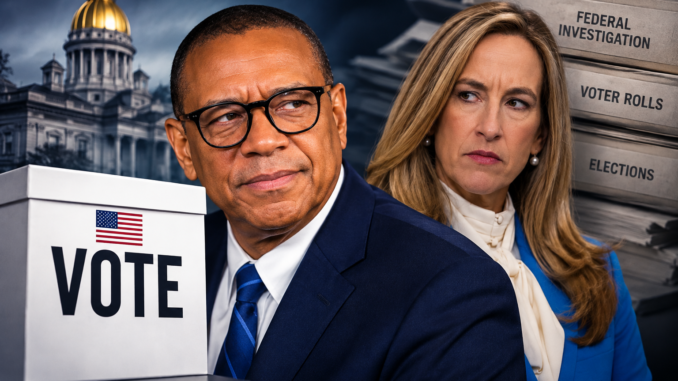
TRENTON, N.J. — Gov. Mikie Sherrill wants Lt. Gov. Dale Caldwell gone following an outside investigation that substantiated sexual harassment and ethics violations.

Those findings are serious if they’re accurate, Save Jerseyans. The Lieutenant Governor, for what it’s worth, is pushing back hard. But equally serious is another question raised by the increasingly tangled timeline surrounding Caldwell, Sherrill and New Jersey’s noncitizen voter-registration scandal:
Did Caldwell’s growing cooperation with federal election investigators give the Sherrill administration another reason to want its lieutenant governor — and chief elections officer — out of the way?
The chronology warrants scrutiny.
Sherrill’s administration retained former Attorney General Christopher Porrino and Lowenstein Sandler on May 21st to investigate Caldwell. Caldwell was formally notified the following day. The investigation followed earlier warnings to Caldwell concerning his conduct toward women according to the official report.
That timing is important. It means the investigation predates the voter-registration scandal that erupted publicly in July. Some of the allegations plaguing Caldwell date back to the campaign period. But what happened after May is equally interesting.
Despite the existence of an investigation and allegations which predate Election 2025, the Sherrill Administration (and the Sherrill campaign before it) never removed Caldwell, publicly disclosed that he was under investigation, or even prevented him from serving as acting governor multiple times when Sherrill left the state on personal, official, or political business. Caldwell continued performing his duties throughout the summer. As recently as late August, Sherrill left New Jersey and Caldwell assumed the powers of governor.
Meanwhile, the state’s election registration crisis was heating up.
In July, under pressure from the Trump Administration, Sherrill revealed that approximately 6,600 individuals who told the MVC they weren’t U.S. citizens had nevertheless been registered to vote because of a “software glitch.” Hundreds subsequently cast ballots.
Caldwell, as secretary of state, oversees the Division of Elections and suddenly found himself at the center of escalating federal scrutiny.
The Justice Department sought records. Congressional Republicans launched their own investigation. Sherrill publicly pushed back, accusing the Trump administration of conducting a “fishing expedition” and warning that personally identifying voter information could be “weaponized.”
Then Caldwell’s posture appeared somewhat different.
In August, an attorney representing Caldwell informed House Republicans that the state would cooperate with their investigation and begin producing certain documents concerning the voter-registration failure. Precisely what Caldwell was willing to provide remained unclear, and the cooperation was far from complete.
Nevertheless, Caldwell was now communicating with federal lawmakers investigating an election scandal carrying obvious political consequences for the administration.
And the public still knew nothing about the investigation hanging over his head.
The Sherrill administration had kept the Caldwell probe undisclosed for more than three months. It did not voluntarily announce it when outside counsel was hired in May. It didn’t announce it when Caldwell continued traveling the state. It didn’t announce it while he repeatedly became acting governor.
The investigation finally became public on September 4th, not because Sherrill disclosed it, but because the New Jersey Globe broke the story. Even then, the administration declined to confirm or deny the investigation.
That distinction raises a potentially more significant question than when the investigation technically began.
If Caldwell’s alleged conduct was serious enough to justify demanding his resignation now, why was the administration comfortable keeping the investigation secret and allowing him to exercise gubernatorial authority for months? And did anything change as Caldwell became increasingly entangled with federal investigators examining New Jersey’s elections?
Chronology isn’t conclusive proof of retaliation, but the administration’s unusual handling of the matter makes transparency about the timeline especially important. Two things can also be truth: (1) Caldwell might be a pig but (2) Sherrill may’ve been disinclined to do much about it until it became clear that the voter registration mess wasn’t going away.
Sherrill could obviously resolve much of the speculation by answering some basic questions:
When did she personally learn about the Caldwell allegations?
Why was Caldwell permitted to continue serving as acting governor after the investigation began?
When did she first consider asking him to resign?
When did she learn Caldwell intended to cooperate with congressional election investigators?
What documents did Caldwell authorize for production?
And were there ever disagreements between Caldwell and the Governor’s Office over responding to federal investigators?
We’re unlikely to find out on Friday. Sherrill’s office announced ‘no public schedule’ for the same day of the governor’s resignation deadline.