TRENTON, N.J. — New Jersey is confronting a brutal affordability crisis. Property taxes are crushing homeowners, utility bills are squeezing families, and the cost of living remains among the highest in America.
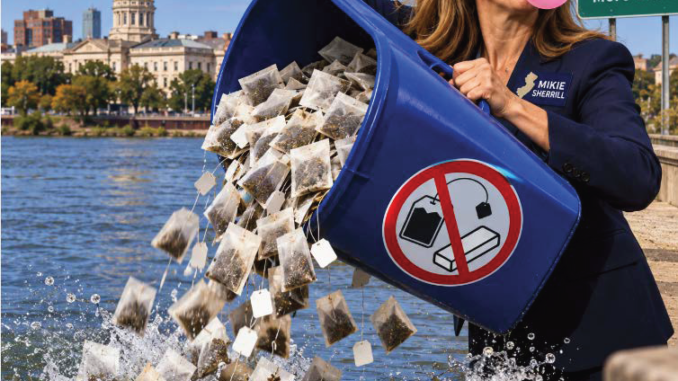
So, naturally, Trenton is coming for your chewing gum and tea bags.
A new bill introduced in the Democrat-controlled State Assembly would prohibit the sale of certain products containing microplastics, including varieties of chewing gum and tea bags, while appropriating $3 million in taxpayer funds for research, enforcement, and environmental programs.
Assembly Bill A5452, dubbed the Protecting Against Microplastics Act, was introduced on September 14th by Democratic Assemblywomen Shama Haider (D-37) and Margie Donlon (D-11).
The legislation specifically identifies chewing gum, tea bags, coffee grounds, talcum powder, and pet food as examples of “potentially ingestible products” subject to its requirements.
Under the proposal, manufacturers would first be required to disclose the presence of intentionally added microplastics or the potential for products to generate secondary microplastics.
Two years after enactment, affected products would face additional labeling requirements, including a warning in English and Spanish:
“This product contains microplastics.”
Three years after enactment, the state would prohibit the sale or distribution of cleaning products, cosmetics, and potentially ingestible products containing intentionally added microplastics or capable of generating certain microplastic particles.
While the bill wouldn’t ban every tea bag or stick of gum outright, its restrictions would apply to products meeting the legislation’s microplastics criteria, with an exception for technically unavoidable trace quantities. At the moment? Pretty much every pack of chewing gum on the market would need to come off the shelves.
Meanwhile, the enforcement provisions are hardly toothless. See what I did there?
The Division of Consumer Affairs (DCA) would be empowered to investigate manufacturers, order noncompliant products off store shelves, and impose civil administrative penalties ranging from $1,000 to $20,000 per violation, with each day of continuing noncompliance constituting a separate offense.
Court-imposed civil penalties could reach $25,000 per day.
And then there’s the price tag…
The legislation appropriates $2.5 million to the Department of Environmental Protection for microplastics research, monitoring, and reduction efforts, plus another $500,000 to the Department of Law and Public Safety for enforcement.
Supporters of microplastics restrictions point to concerns about their potential environmental and human health effects. Those concerns aren’t necessarily imaginary (scientists are still researching the extent to which they’re dangerous, and in which quantities), but the timing and priorities invite taxpayers scrutiny, Save Jerseyans.
New Jersey already has one of the nation’s most punishing affordability problems. Families are struggling with property taxes, housing costs, electric bills, and the everyday expense of raising children in the Garden State. Businesses are contending with their own escalating costs and regulatory burdens.
Yet instead of concentrating their legislative energies on making New Jersey more affordable, lawmakers are once again spending time and taxpayer dollars regulating increasingly marginal aspects of everyday life.
It’s a familiar Trenton pattern: tackle the small stuff with sweeping mandates, new enforcement powers, and another taxpayer-funded government program while the much bigger problems remain unresolved.
The legislation also raises practical questions about compliance costs for manufacturers and whether those expenses could ultimately be passed along to consumers.
For now, A5452 remains proposed legislation, not state law.
New Jerseyans can still enjoy their tea and chewing gum without running afoul of Trenton’s latest proposed product restrictions.
Whether they’ll be able to afford the electric bill while brewing that tea is another question entirely.