
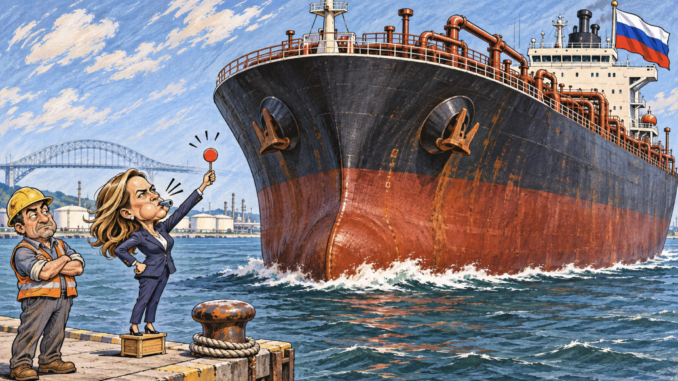
ELIZABETH, N.J. – Governor Mikie Sherrill warned New Jersey port operators on Election Eve that unloading Russian diesel could expose them to millions of dollars in penalties.


Her letter leaves a basic question unanswered. If a terminal accepts the fuel under a U.S. Treasury license, what authority does the governor have to stop it?
Sherrill said Monday that at least one tanker carrying Russian diesel may be headed for the New Jersey coast. She urged operators to turn away any such shipment and warned that they could face penalties equal to the value of the cargo “long after Trump has left office and his corrupt administration has come to an end.”
The penalty Sherrill cited is federal. Her letter identifies no state statute or regulation authorizing her to bar the cargo. It announces no order closing a terminal to an incoming vessel. Yet if operators turn tankers away rather than risk a multimillion-dollar penalty, Sherrill could effectively block the shipments in New Jersey without ever having to establish that she has the power to do so.
Washington’s position is spelled out in writing.
On October 9th, Treasury’s Office of Foreign Assets Control issued General License 135, expressly authorizing transactions involving the delivery, unloading and importation of Russian diesel into the United States under two federal sanctions programs.
Sherrill argues that Treasury exceeded its authority. Congress banned Russian energy imports in 2022 and set conditions for lifting the ban, including a presidential certification that Russia had agreed to withdraw its forces from Ukraine. The same statute, however, ties implementation to a Biden executive order that expressly contemplates licenses.
The dispute turns in part on whether Treasury can temporarily license diesel imports while the broader ban remains in force.
Even if Sherrill is right about the limits of Treasury’s power, that still leaves the question of her own. Her letter cites no court ruling striking down the license and names no New Jersey terminal that has agreed to accept the fuel. For now, the governor has told port operators what she believes Washington got wrong.
She has yet to identify what gives Trenton the final say at the dock.